




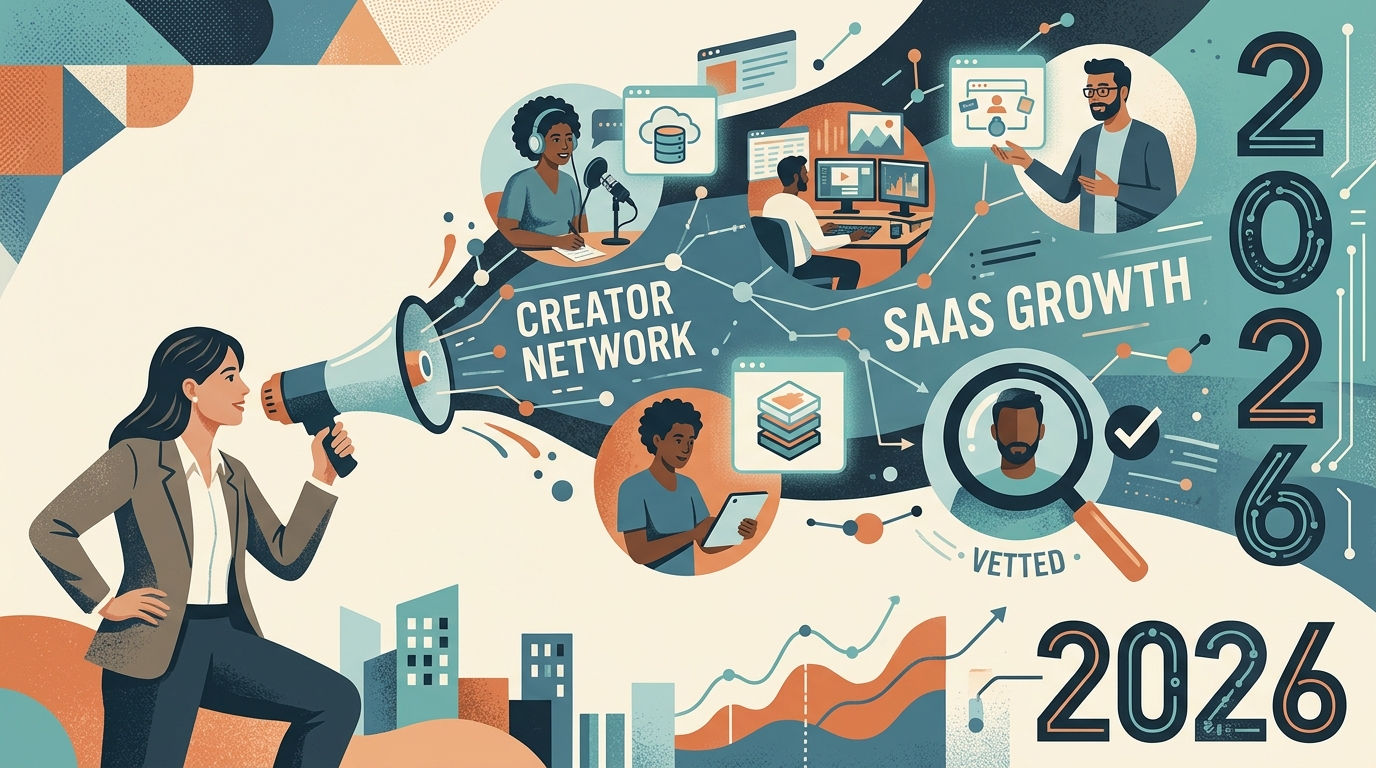
TL;DR: SaaS influencer marketing works because B2B buyers trust a small set of niche voices — developer advocates, LinkedIn operators, and technical YouTubers — more than they trust ads. Unlike B2C, it prioritizes audience relevance over reach, because software is a considered, committee-driven purchase, not an impulse buy. To find and vet the right creators, start from your ideal customer profile, search across every platform at once, then check engagement quality, topical relevance, and values fit before you reach out.
SaaS influencer marketing is one of the most misunderstood channels in B2B growth. When most people hear “influencer,” they picture a lifestyle creator holding up a skincare bottle. But for software companies, the creators who move the needle look nothing like that. They’re developer advocates writing threads about your API, fractional CTOs breaking down architecture on LinkedIn, and YouTubers who spend twenty minutes actually building something with your tool.
If you sell software, this guide walks you through why SaaS influencer marketing works, how it differs from the B2C version, and exactly how to find and vet the right people.
The short version: your buyers already trust a small set of niche voices more than they trust your ads. SaaS influencer marketing is the practice of getting your product in front of — and endorsed by — those voices, in a way that feels like a genuine recommendation rather than a paid placement. Done right, it compresses the trust-building part of your funnel from months to a single credible mention.
Why SaaS Influencer Marketing Actually Works
SaaS influencer marketing works because software is a considered purchase, and buyers trust people they already respect more than they trust an ad. Nobody adopts a new database, CRM, or analytics tool on impulse — they read, compare, and ask around first. When a developer your audience follows says “I’ve been using this for three weeks and it’s replaced two tools in my stack,” that single sentence carries more weight than a month of retargeting.
It short-circuits the skepticism a cold ad never gets past. There are three structural reasons the channel performs. First, trust transfers: the creator has spent years earning credibility with a specific audience, and a genuine endorsement lends you a slice of it. Second, context is built in: a good creator doesn’t just name-drop your product, they show it solving a problem their audience already has, which does your positioning work for you.
Third, the content compounds: a YouTube tutorial or a well-written thread keeps driving qualified signups for months or years after it ships, unlike paid impressions that vanish the moment you stop paying.
The catch is that SaaS influencer marketing rewards precision and punishes spray-and-pray. A single relevant developer advocate with 12,000 engaged followers will out-convert a generalist with 500,000 followers who has never touched your category. That’s why the hard part isn’t the budget — it’s the finding.
Manually screening candidates across LinkedIn, YouTube, and X eats a full afternoon per campaign. Lessie searches 100+ live sources in one pass and hands you verified contact details, so you spend your time vetting real candidates instead of hunting for them.
How It Differs From B2C Influencer Marketing
SaaS influencer marketing differs from B2C in almost every dimension: audience relevance beats reach, proof beats aspiration, and a slower, committee-driven buying process replaces the impulse purchase. Run a SaaS campaign with the B2C playbook and you’ll waste your budget chasing follower counts that never convert.
- Reach vs. relevance. B2C often chases raw follower counts because the product appeals to a broad audience. In SaaS, audience fit dominates — you want the person whose followers are literally your ideal customer profile, even if that’s a few thousand people.
- Aspiration vs. proof. B2C creators sell a feeling or a lifestyle. SaaS creators sell proof: a live demo, a benchmark, a before-and-after of their workflow. Your product has to survive being used on camera.
- Impulse vs. committee. A B2C purchase can happen in the same scroll as the post. A SaaS purchase involves evaluation, budget approval, and often a team. The creator’s job is to start and de-risk that journey, not close it.
- Platform mix. B2C lives on Instagram and TikTok. SaaS influence concentrates on LinkedIn, YouTube, X, developer newsletters, podcasts, and niche communities like Discord and Slack — places where professionals actually make tooling decisions.
- Attribution horizon. B2C measures a spike in the next 48 hours. SaaS measures pipeline that materializes weeks later, so you need to instrument the campaign for a longer, softer attribution window.
The practical takeaway: stop thinking about audience size and start thinking about audience overlap. The best SaaS influencer marketing partners are often people you’d never describe as “influencers” at all — they’d call themselves engineers, founders, or operators who happen to have a following.
The Four Types of SaaS Influencers
Four types of SaaS influencers matter: independent creators and educators, developer advocates, LinkedIn thought leaders, and YouTubers or long-form reviewers. Matching the type to your goal, not chasing whoever is loudest this week, is half the battle —treat it as a map, not a popularity contest.
Independent creators and educators are the closest thing to classic influencers in the SaaS world. They run YouTube channels, newsletters, or course businesses teaching a category — no-code, data engineering, indie SaaS, growth — and they naturally recommend the tools they use. They’re ideal for top-of-funnel awareness and for reaching practitioners who are actively learning.
Developer advocates and technical creators matter enormously if you sell to engineers. These are the people posting working code, teardowns, and honest “I tried it” reviews. A single credible dev advocate can drive more qualified trials than a paid campaign because their audience trusts them to call out anything that doesn’t actually work. If this is your motion, our developer advocate finder is built precisely for surfacing them.
LinkedIn thought leaders are the engine of B2B SaaS influence. Fractional executives, category experts, and operators with engaged LinkedIn audiences shape how buyers think about a problem before they ever start a vendor evaluation. A single well-framed post from the right voice can seed an entire buying committee. These creators are perfect for reaching decision-makers rather than individual practitioners.
YouTubers and long-form reviewers produce the content buyers watch when they’re deep in evaluation — tutorials, comparisons, and “how I use X”workflow videos. Because the format is long and search-indexed, these placements keep driving high-intent traffic for years. If YouTube is central to your plan, tools like find YouTube creators help you filter for channels whose audience matches your ICP.
Use LinkedIn voices and educators to create demand (awareness and framing), and use developer advocates and YouTube reviewers to capture demand (evaluation and trial). Running both in parallel is how you keep a campaign from being a one-off spike.
How to Find and Vet the Right Influencers
Finding the right SaaS influencer means starting from your ideal customer profile, searching across every platform at once, then vetting for engagement quality, topical relevance, and values fit — in that order. Finding a big account is easy; finding the right one is where most SaaS influencer marketing programs live or die. Here’s the six-step process we recommend.
- 1Define the audience you need to reach, not the creator you want
Start from your ideal customer profile and work backwards. Write down the exact role, seniority, tech stack, and problem your best customers share. Your creator shortlist should be “people whose followers look like this” — not“people with big numbers.” This one reframe filters out most of the mismatches before you spend a dollar.
- 2Search across platforms, not just one
The right voice for your category might be on LinkedIn, YouTube, X, a newsletter, or a podcast — and you won’t know until you look everywhere at once. Manually hopping between platforms is slow and leaves gaps. This is exactly where AI people search earns its keep: describe the audience and topic in plain language and get a cross-platform list back in one pass.
- 3Check engagement quality, not just quantity
Look past follower counts. Are the comments substantive or generic? Do real practitioners reply, or is it bots and mutual-promo accounts? A creator with 8,000 followers and thoughtful technical discussion in every thread is worth more than one with 200,000 passive followers. Pull up their last ten posts and read the replies.
- 4Verify topical relevance over time
A creator who consistently covers your category will produce a far more credible endorsement than someone doing a one-off paid post outside their usual lane. Scan six months of their content. If your product fits naturally into what they already talk about, the collaboration will feel authentic to their audience.
- 5Confirm brand and values fit
Read how they talk about other tools. Are they honest and specific, or do they promote anything that pays? You want partners whose credibility you’re borrowing, which means their standards protect your reputation too. A creator known for candid reviews makes your endorsement more valuable, not less.
- 6Find a real contact and reach out with context
Generic “love your content, want to collab?” DMs get ignored. Reference a specific post, explain why your product fits their audience, and be upfront about terms. The bottleneck is usually getting a reliable email or the right channel —Lessie surfaces verified contact details alongside each creator so you skip the dead-end DM entirely.
Campaign Structures That Work for SaaS
Four campaign structures reliably outperform a plain sponsored post for SaaS: hands-on reviews, long-term ambassador relationships, co-created educational content, and affiliate partnerships. All center on genuine use, because SaaS audiences are allergic to anything that smells like an ad read.
- Hands-on reviews and build-alongs ask the creator to actually use your product and show the result — a YouTube walkthrough, a thread documenting a real workflow, a live stream. This is the highest-trust format because the audience watches your product survive contact with reality.
- Long-term ambassador relationships beat one-off posts: a creator who mentions you naturally over months, as a genuine part of their stack, drives compounding trust that a single burst never matches.
- Co-created educational content — a webinar, a template, a teardown you build together — gives the creator something valuable to share and gives you an evergreen asset.
- Affiliate or referral partnerships align incentives for creators who want ongoing upside tied to real signups rather than a flat fee.
The hardest part of any of these structures is building a clean list of relevant creators with real contact details. Lessie searches 100+ live sources across every platform, filters by audience and topic, and hands you verified emails — so you spend your time on the pitch, not the prospecting.
Measuring ROI Without Fooling Yourself
SaaS influencer marketing is measurable, but not on the 48-hour timeline B2C uses. Because the buying journey is longer, you have to instrument for both the immediate signal and the pipeline that shows up later. Give each collaboration a unique tracking link or discount code so you can attribute direct signups, then layer on softer signals: branded search lift, new trial accounts that match the creator’s audience profile, and self-reported “how did you hear about us” answers at signup.
The metrics that actually matter are downstream of clicks. Track qualified trials (not just traffic), trial-to-paid conversion for creator-sourced accounts, and ultimately revenue and retention from those cohorts. A creator whose audience signs up and sticks is worth ten who drive a spike of tire-kickers. Give each placement a realistic attribution window — 30 to 90 days is common for SaaS — and judge the channel on cost per qualified opportunity, not cost per click.
If you want to go deeper on measurement and channel strategy, the Lessie blog covers the broader growth playbook.
How Lessie Helps You Run SaaS Influencer Marketing at Scale
Everything above hinges on one bottleneck: finding the right creators and reaching them efficiently. That’s the exact problem Lessie is built to solve. Instead of manually combing LinkedIn, YouTube, X, and newsletters one at a time, you describe the audience and topic you need in plain language and Lessie’s agentic search queries 100+ live sources at once — surfacing developer advocates, LinkedIn voices, niche YouTubers, and newsletter authors who match your ICP, along with verified contact details for each.
- Cross-platform discovery. One search spans every place SaaS creators live, so you don’t miss the perfect fit just because they’re on a platform you forgot to check. Purpose-built entry points like influencer search and the brand creator finder narrow the field fast.
- Audience-first filtering. Filter by the audience a creator actually reaches, not just their raw follower count — the relevance-over-reach principle, operationalized.
- Verified contact details. Every creator comes with a real, verified way to reach them at 95%+ accuracy, so your outreach lands in an inbox instead of a full DM folder.
- Built-in outreach. Lessie can draft personalized outreach that references each creator’s actual work, which is the difference between a reply and being ignored.
If you already have a broader influencer program, the same engine powers general influencer marketing workflows too —SaaS is simply the highest-precision use case for it. The result is a repeatable pipeline: define the audience, discover the creators, vet them against the checklist above, and reach out with context — all in a fraction of the time a manual process takes.