




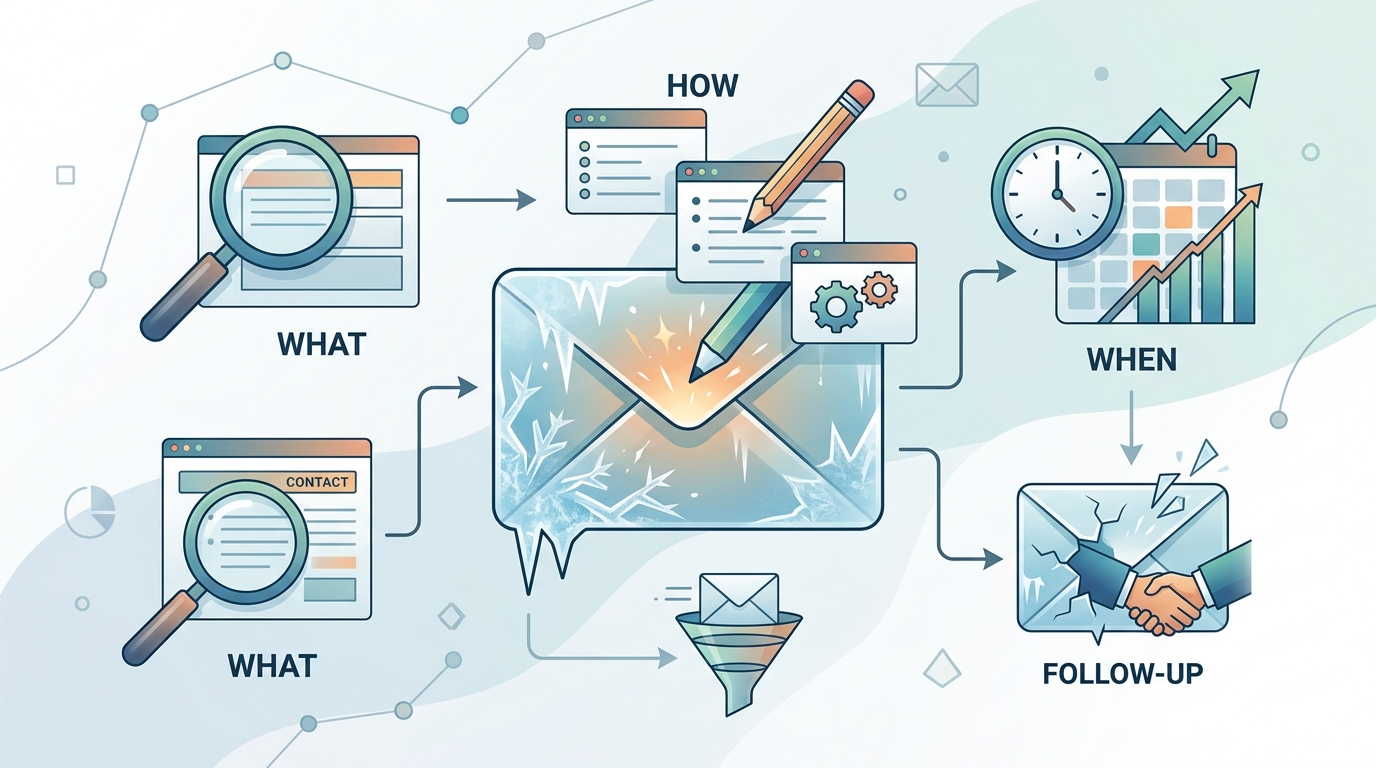
TL;DR: Cold email is unsolicited, one-to-one email to a business contact you have no prior relationship with—legal in most markets when it follows the rules, and effective when it is relevant, brief, and well-timed. This guide covers the whole discipline: what cold email is (and is not), the compliance basics, the structure of a first email that earns replies, the follow-up rhythm that produces most of them, the mistakes that kill deliverability—and why when you send increasingly beats what you write.
Cold email has survived every obituary written for it. It survives because the underlying act is sound: one professional writing to another with something genuinely relevant to say. What died—deservedly—is the spray: thousands of identical messages hoping volume substitutes for relevance. The gap between those two practices is the subject of this guide.
What Is Cold Email?
Cold email is a first-touch message sent to a business contact who has not interacted with you before—no form fill, no meeting, no relationship. It differs from spam in intent and construction: a cold email is individually relevant, sent one-to-one for a specific business reason, and easy to decline. It differs from marketing email in consent mechanics: newsletters go to people who opted in; cold email earns its place with relevance instead.
The compliance floor. Rules differ by market, but the pattern is consistent: identify yourself honestly (no misleading sender names or subject lines), make opting out easy and honor it promptly, and include a legitimate business address—the core of the US CAN-SPAM requirements. European GDPR practice adds a stricter bar: a demonstrable legitimate interest for processing someone's contact data, which in practice means writing only to people whose role genuinely relates to what you offer. B2B cold email done this way is lawful in most major markets; indiscriminate bulk mail is what regulation exists to punish.
The economics. Cold email remains the cheapest scalable outbound channel, which is exactly why inboxes are crowded and reply rates for generic sends sit in the low single digits. The teams beating that baseline are not writing better templates—they are choosing better recipients and better moments.
How Do You Write a Cold Email That Gets Replies?
A reply-worthy cold email makes one relevant point and asks one small question—in under 120 words. Every element earns its place or gets cut.
- Subject line: specific and plain. Say what the email is about in the recipient's language—"question about your SDR hiring" beats any clickbait pattern. Curiosity tricks buy opens and spend trust.
- Opener: their situation, not your introduction. The first line decides the delete. Lead with the observation that makes this email theirs—the hiring surge, the post they wrote, the launch—never "My name is" or "I hope this finds you well."
- Body: one problem, one credibility point. Connect their situation to a problem you solve and give exactly one reason to believe you—a result, a relevant customer, a specific number. Two sentences.
- Ask: small and answerable. "Worth a look?" outperforms "Do you have 30 minutes Tuesday?" The first reply's job is to open a conversation, not close a calendar slot.
- Sign-off: human and complete. A real name, a real title, no gimmicks. Even the closing line carries signal—our guide to the warm regards sign-off covers what different closings communicate.
Drafting from a blank page is where most reps lose an hour a day. The cold email generator produces a structured first draft from your product and audience inputs—edit it into your voice rather than starting from nothing.
What Is the Right Cold Email Follow-Up Strategy?
Most replies come after the first email, not from it—which makes the follow-up sequence the highest-yield part of the channel and the most commonly botched. The right strategy is three to four touches over two to three weeks, each adding something new.
The rhythm. A proven default: follow up three days after the first email, then five to seven days later, then a final note a week after that. Tighter spacing reads as pressure; looser spacing loses the thread. Adjust for seniority—executives skim on longer cycles.
The content rule: never "just bumping." Each follow-up should justify its own existence—a new angle on the problem, a relevant result, a resource worth keeping, or a fresh signal ("saw you just opened the Austin office"). A bump adds pressure without adding reasons; three bumps teach the prospect to ignore you. The full messaging playbook, including what to write when silence continues, is in our guide to the follow-up email after no response.
The exit. End sequences gracefully. A short final note that closes the loop without guilt ("I'll stop here—if timing changes, you know where I am") leaves the door open and routinely produces replies on its own. Generating the whole sequence—spacing, angles, and exit—is what the follow-up email generator does from a one-line description of the situation.
Which Cold Email Mistakes Kill Deliverability?
Deliverability—whether your email reaches an inbox at all—is won or lost on inputs and volume patterns before copy ever matters. Four mistakes account for most burned domains:
- Sending to unverified addresses. Bounces are the loudest spam signal a domain can emit. Verify every list before sending—the email verifier catches dead and risky addresses in bulk before they cost you inbox placement.
- Volume spikes from a cold domain. Going from zero to five hundred sends a day looks exactly like what it is. Warm up gradually and keep daily volume inside human-plausible bounds per sender.
- Identical bodies at scale. Hundreds of same-text messages pattern-match to bulk mail. Signal-anchored personalization varies your content naturally—a deliverability benefit on top of the relevance one.
- Ignoring the basics. Missing authentication records, no unsubscribe path, misleading subject lines—each is independently enough to route you to spam and, in some markets, into legal exposure.
Why Does Timing Beat Copy in Cold Email Now?
Because copy quality has been commoditized and timing has not. AI made competent cold email universal—every inbox now receives well-written, personalized-sounding messages daily. What AI cannot fake is arriving at the moment the recipient actually has the problem funded and top of mind. That moment is observable: funding rounds, leadership changes, hiring surges, and the other events that mark a buying window opening.
The practical shift: instead of writing one great email and sending it to a thousand people, find the hundred people whose signals say this quarter and write to the moment. Same channel, opposite selection logic—and it compounds, because signal-timed email protects deliverability (varied content, engaged recipients) while volume email erodes it. This is the thesis behind AI sales assistant workflows that pair signal detection with drafting: the machine finds the moment and the reason; you own the conversation.